The Early Years of Immortelle: 2019 - The House Emerges
By 2019, Immortelle had outgrown her original walls.
What had taken root the year before was now pressing outward—not from excess, but from necessity. The work had expanded in clarity and ambition, and the house was required to answer it in kind.
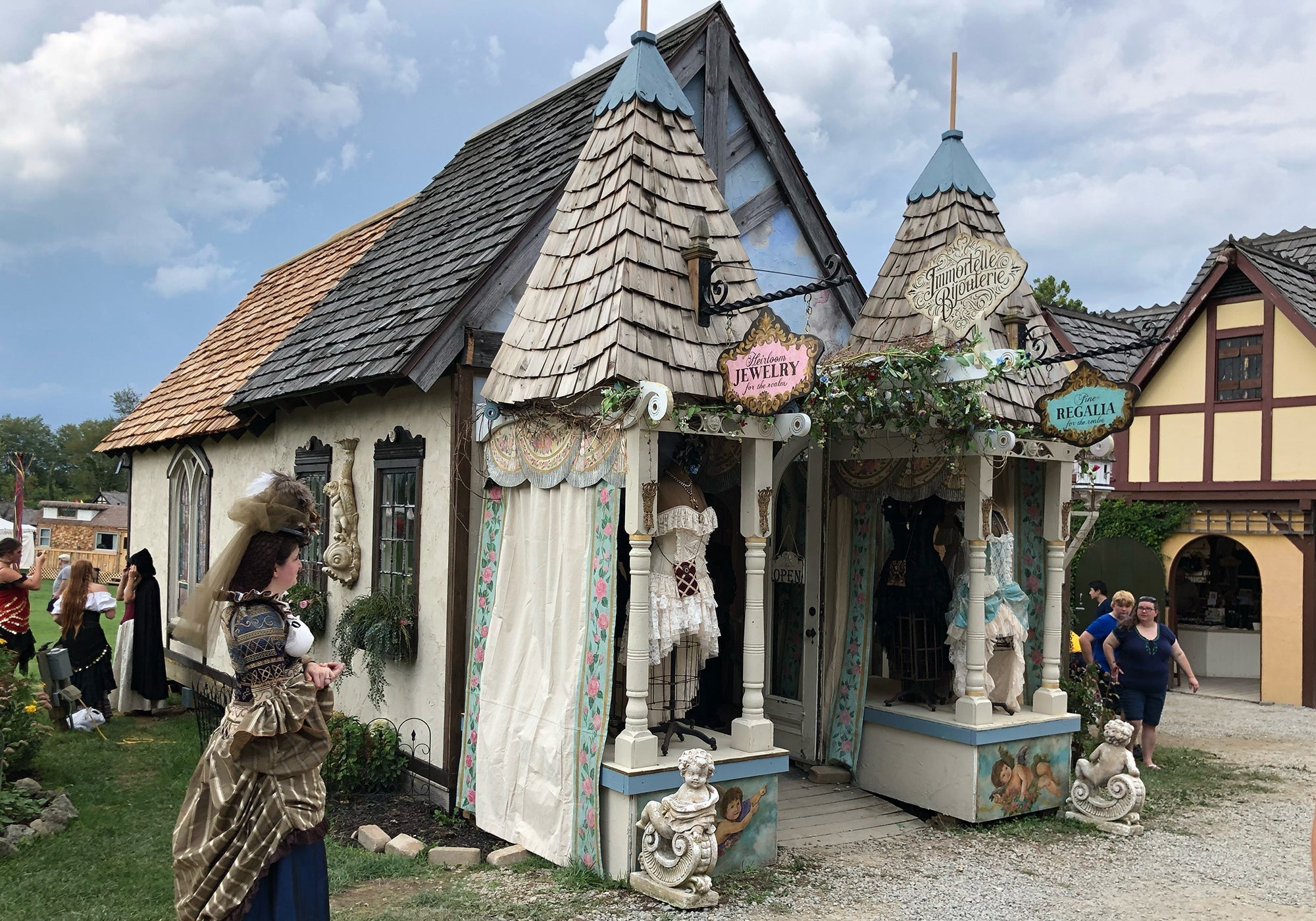
That year marked the most significant physical expansion in Immortelle’s history.
A twelve-by-sixteen-foot structure was added to the rear of the original building, extending the house beyond its initial footprint. This addition was not conceived as storage, but as continuation—a space built to properly hold the growing body of dresses, corsets, and garments that had begun to define the atelier’s language.
The expansion was anchored by history.
Antique stained-glass windows salvaged from a Gothic church dating to 1840 were brought into the house, carrying with them filtered light and quiet gravity. These windows were never meant to be merely decorative. They altered the interior atmosphere entirely, lending the space a sense of reverence—light broken into color, time layered into presence.
Salvaged antique back doors were set in place, reinforcing the idea that every threshold mattered.
At the front of the house, plinths crowned with widow’s peaks were raised—architectural stages rather than displays. For the first time, dress forms could stand upright and visible, garments and jewelry presented together as a unified composition. These plinths transformed the facade into a formal introduction, allowing the work to be read before it was entered.
Inside, the house continued to evolve.
Six antique chandeliers were hung, each chosen for proportion and character rather than symmetry. Their presence softened the space while anchoring it in ceremony. Formal dress closets were built to house the growing garment collection—spaces designed not for hiding, but for care, order, and longevity.
This was also the year Immortelle opened her first dressing room.
With it came the presence of a large Victorian mirror—one that still graces the shop today. More than a reflective surface, it became a witness. A place where garments were tried, adjusted, inhabited. Where posture changed. Where presence was first recognized.
This expansion altered the rhythm of the house.
The dresses were no longer incidental.
The corsets no longer stood alone.
The work had space to speak.
2019 was not about growth for its own sake. It was about refinement—about giving each element the room it required to be understood. The atelier was no longer discovering its voice. It was shaping it.
The house had expanded.
But more importantly, it had clarified.
Immortelle was no longer a small shop that happened to make garments.
She was a house built to hold them.