The Early Years of Immortelle: 2020 — The Year of Stewardship
In 2020, the world went quiet.
The Ohio Renaissance Festival did not open its gates, and the rhythm that had come to define each year was suddenly interrupted. There were no crowds, no gatherings, no procession of days shaped by bells and music. Immortelle did not disappear during this pause — she turned inward.
What could not be done outwardly was undertaken within.
This year became one of stewardship — the careful tending of what already existed, the deepening of structure rather than expansion of footprint. With the house closed to the public, the work shifted from presentation to preservation.
Every floor within Immortelle was refinished by hand. Brian and I worked on our hands and knees, board by board, restoring surfaces already worn smooth by years of movement and making. It was slow, exacting work — the kind that tests resolve rather than skill. I do not often quit anything, but this project nearly bested me. Completing it became an act of endurance as much as restoration.
Throughout the house, refinement replaced construction. A vintage Victorian-inspired hutch was carefully built into the front of the shop, anchoring the space with permanence and weight. A new antique counter took its place beneath a canopy softened with antique French curtains, introducing a sense of enclosure and intimacy at the threshold. The front entrance walkway was replaced, reshaping the approach to the house and reinforcing the idea that Immortelle is entered deliberately, not passed through casually.
This was also the year we began working with an artist to paint the decorative busts that now appear throughout the shop. Each bust was conceived as an object of display rather than utility — painted in the color language of historically significant gowns, intended to hold jewelry while quietly referencing the garments that inspired them. These figures became sentinels within the space, neither mannequin nor statue, but something in between.
Antique French curtains were added to the tops of the dress cabinets, softening their architectural lines and reinforcing the idea that even storage within Immortelle is ceremonial. At the same time, custom shutters were built to protect the stained glass windows salvaged from an 1840s Gothic church. This was not an aesthetic decision, but an act of guardianship. The shutters allow the house to close itself when at rest, reinforcing the belief that Immortelle is not simply displayed — she is cared for, opened and closed with intention.
It was during this inward year that we encountered one of the most defining presences in the house.
At an antique mall in Florence, Kentucky, we found a twenty-four-light chandelier — monumental, reverent, and unmistakable in its bearing. Known as an Ave Maria chandelier, it carried the gravity of devotion rather than ornament. Where many chandeliers sparkle, this one presides. It now graces the back salon of the shop, casting light downward with restraint and purpose. When illuminated, it does not perform — it blesses.
Finding it felt less like acquisition and more like recognition, as though it had been waiting for a ceiling that understood it.
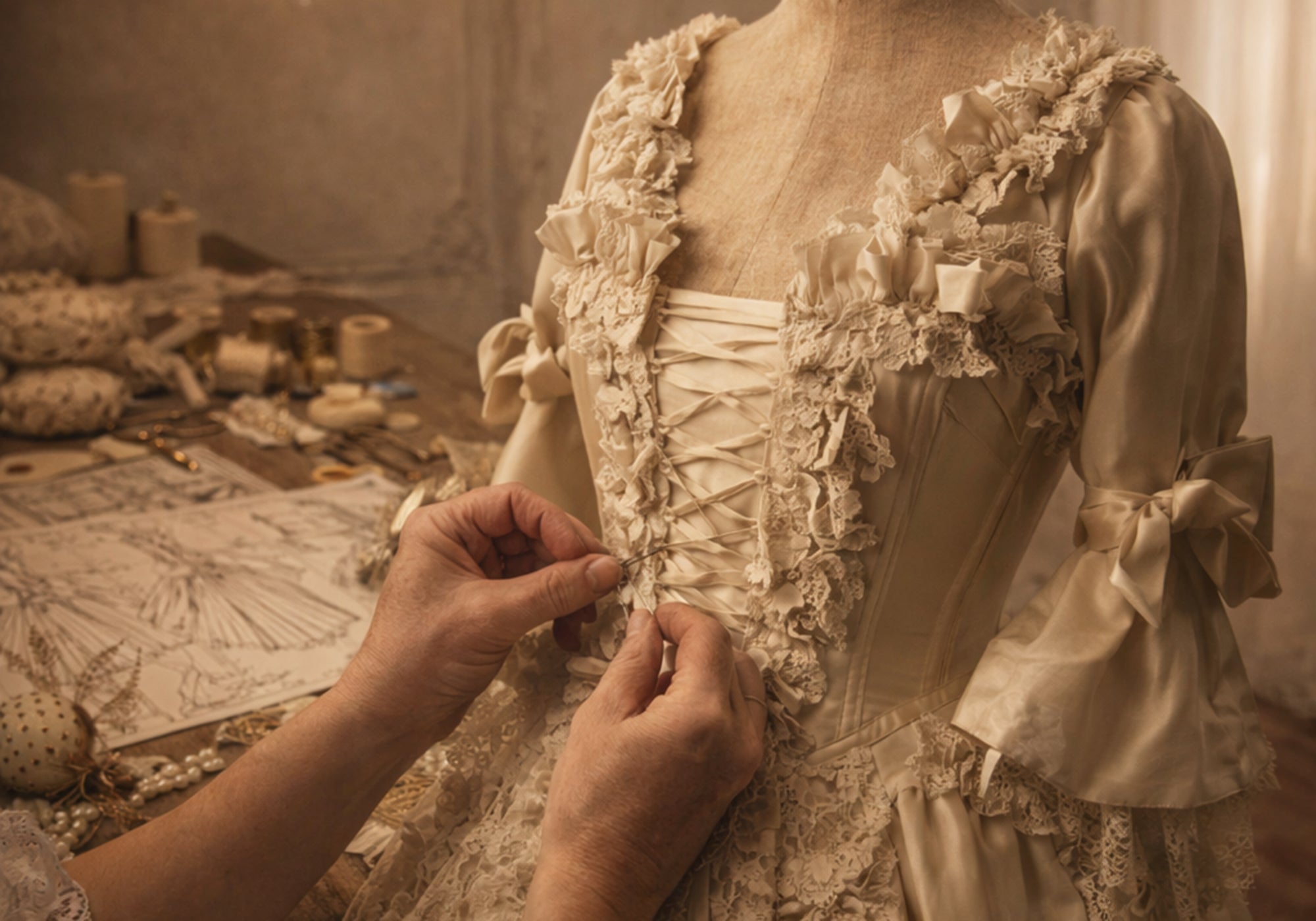
2020 was also the year the Immortelle Gown was perfected — the first complete house design conceived entirely within Immortelle. While earlier garments had been joint efforts, this gown emerged solely from my hand: from drawing to patterning, sampling to final execution. It was the moment when Immortelle’s design language fully cohered — not borrowed, not shared, but authored.
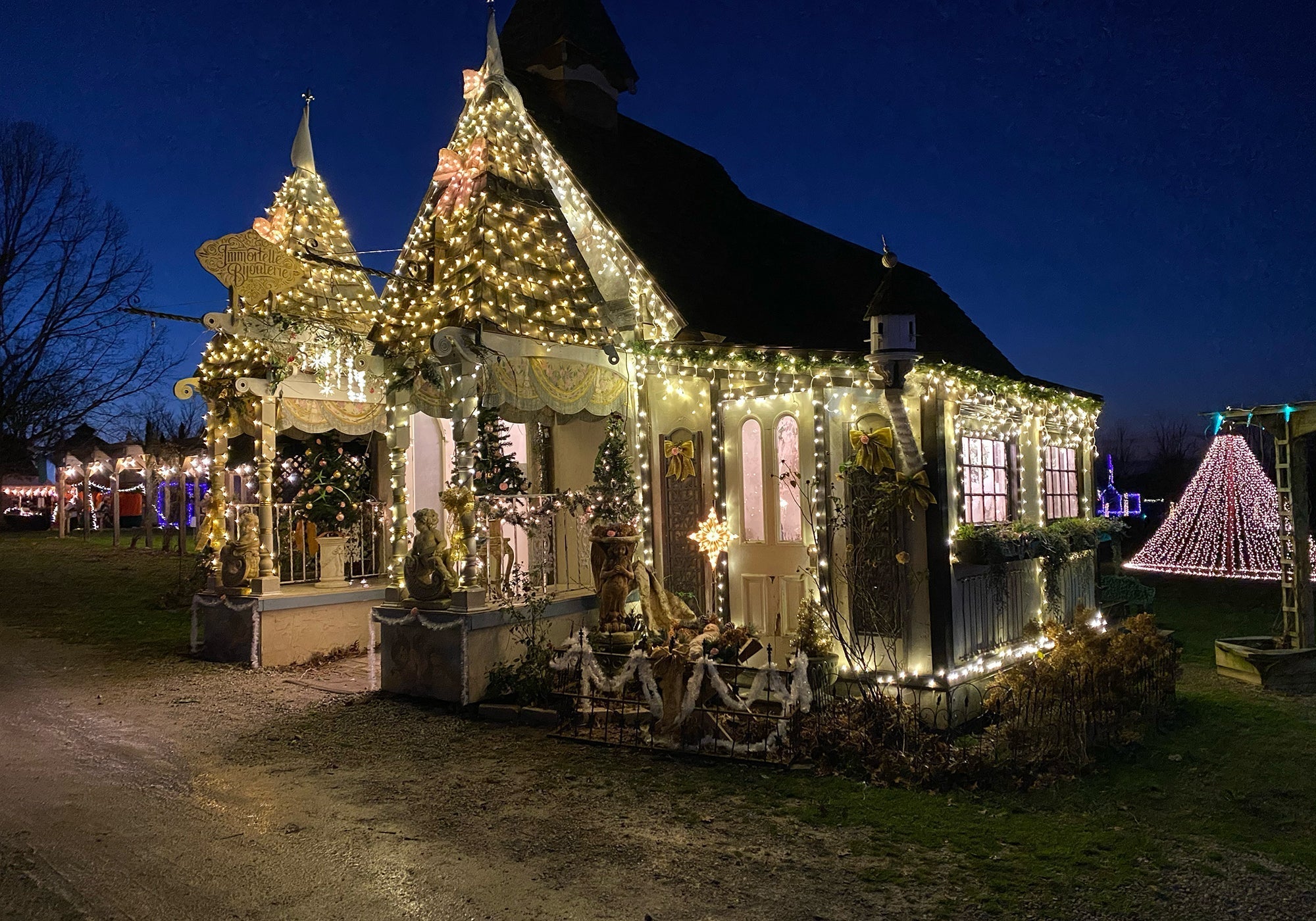
This was also the inaugural year of Yuletide Village at the Ohio Renaissance Festival — a winter counterpart to the faire that Immortelle has attended since its inception. Though the year was marked by absence, it also quietly introduced continuity that would endure.
Nothing in 2020 was rushed. Nothing was decorative without purpose. This was not a year of spectacle, but of resolve.
Immortelle was not assembled during this time.
She was tended.
The house learned how to rest.
The work learned how to endure.
And the foundation deepened — not outward, but inward — preparing for what would come next.